
London Falling, Part II:
(Glad I Did Not) Say Nothing

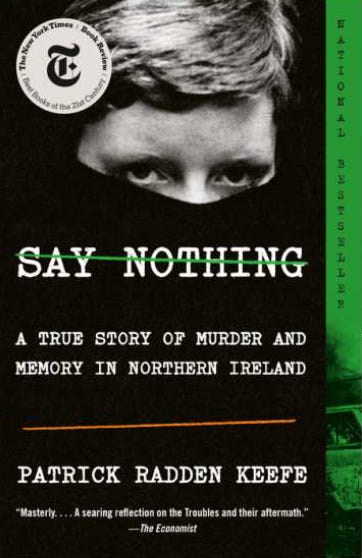
Whenever I go to New York City, I buy a book. Last week I picked up Say Nothing, Patrick Radden Keefe’s 2019 best-seller about the Troubles in Northern Ireland, which I was inspired to read after devouring London Falling, his current best-seller, about a couple who learn that their 19-year-old son, who died after falling from the fifth-floor balcony of a luxury high-rise in London, had been passing himself off as the son of a Russian oligarch.
Two days after I bought Say Nothing, when my husband and I boarded Air Canada 8463 for the first leg of our trip home to Edmonton, I convinced myself that Keefe was on our plane. It was nuts, I know. What are the odds that the guy who had been standing in front of Dave and me in the Zone 1 lineup was the author of the book I planned to read on that very flight?
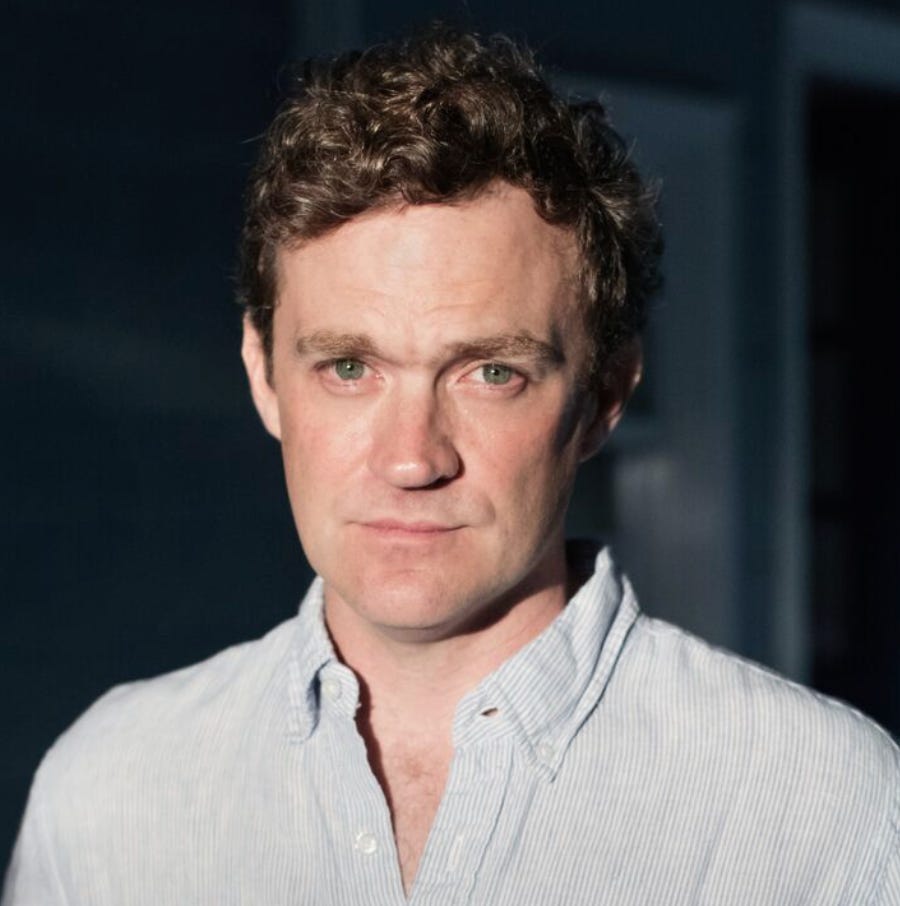
My evidence was scanty, but I pegged him for a literary type because I noticed that along with his boarding pass, he was holding an advanced reader copy of a book (whose title I couldn’t quite make out) while removing a tweedy (author-like) jacket from his suitcase, which was upright and barely unzipped. I had yet to see his face, but I was impressed with his dexterity and his wardrobe.
I didn’t consider that he was Keefe until I walked past him on the plane. He was in business class (more evidence) and I concluded that he could very well be the best-selling writer whose book was tucked away in my backpack. But Dave and I were being herded back to steerage so I didn’t have time for more than a fleeting glance.
“I think the guy in front of us in the boarding line was Patrick Radden Keefe,” I said to Dave, who has been listening to me going on about London Falling since I learned about the book and realized that 45 years ago I spent a memorably awkward evening with the dead young man’s mother and her family.
London Falling sent me on an extended trip down Memory Lane, one that helped me to understand the evening from a more clear-headed, mature, and compassionate perspective. (I wrote about it here.) For me, it was healing. But Dave was growing weary of my obsessive nostalgia, not to mention my habit of mistakenly thinking I recognize someone when I absolutely do not.
“It’s not him,” he said, giving me the sort of pitying look I would have given him if he’d told me he’d traveled back in time and bumped into Linus Pauling and Albert Einstein on a commuter train.1


When all the passengers were seated and the pilot announced that we were going to be stuck on the tarmac for another 40 minutes—this after we’d boarded an hour late—I flagged down a flight attendant, a guy who looked to be around my kids’ age. I showed him a picture of Keefe and pointed to the second row in business class. “Do you think this is that guy?” I asked.
The flight attendant was confused. “Who is he?” he asked.
I held up Say Nothing. “He wrote this book,” I said.
The flight attendant gave me a look similar to the one Dave had graced me with a few minutes earlier. But he wasn’t my husband and also, he had nothing to do for the next 40 minutes. He walked up the aisle, pivoted at the guy’s seat, looked down, and headed back to me. I prayed the guy had been buried in his ARC and hadn’t noticed.
“It’s not him,” the flight attendant said. As he sauntered off, Dave awoke from the nap he’d pretended to be taking in an effort to make it clear that he didn’t know me. “I told you,” he said.
“I know,” I replied. I was not offended. As noted, I’ve made these kinds of mistakes before. I opened Say Nothing and continued reading about Dolours Price, the IRA loyalist who was partly responsible for the death of Jean McConville, a 38-year-old widowed mother of 10 children who was dragged from her home in Belfast in 1972 and never seen again. About 30 minutes before the flight landed I was nearly halfway through the book when the flight attendant reappeared next to my seat.
“It is him,” he said. “I checked.”
Dave was really asleep this time,2 but instead of poking him to say, “I was right! I told you so!” I asked the flight attendant if he would ask Keefe to sign my book. He responded as if I’d asked him for 10 cookies and 30 packages of pretzels: with stunned silence. If a thought bubble had appeared above his head in that moment, it would have read “Why didn’t I listen to my mother and become an undertaker?”
I was about to explain that authors like to sign books because it means the books can’t be returned to the bookseller. But before I had a chance, the flight attendant turned and headed back up to business class. I watched as he leaned over and spoke to Keefe, who nodded. I crossed “Deborah J. Waldman” off my boarding pass and wrote “Debby,” stuck it in the book, and handed it to the flight attendant.
Then I wrote a note to Keefe, thanking him and sharing the story about how I’d come to meet Rachelle Gryn Brettler, the mother in London Calling. Because I hadn’t thought to bring stationary with me, I used the barf bag I found in the seat pocket. I had plenty of time, because the flight attendant was waylaid on his way back to my seat by another passenger in business class. I watched as he showed her the book, wondering what they were talking about.
“She said she read it,” he explained when he got back to my seat. “She thought it was great.”
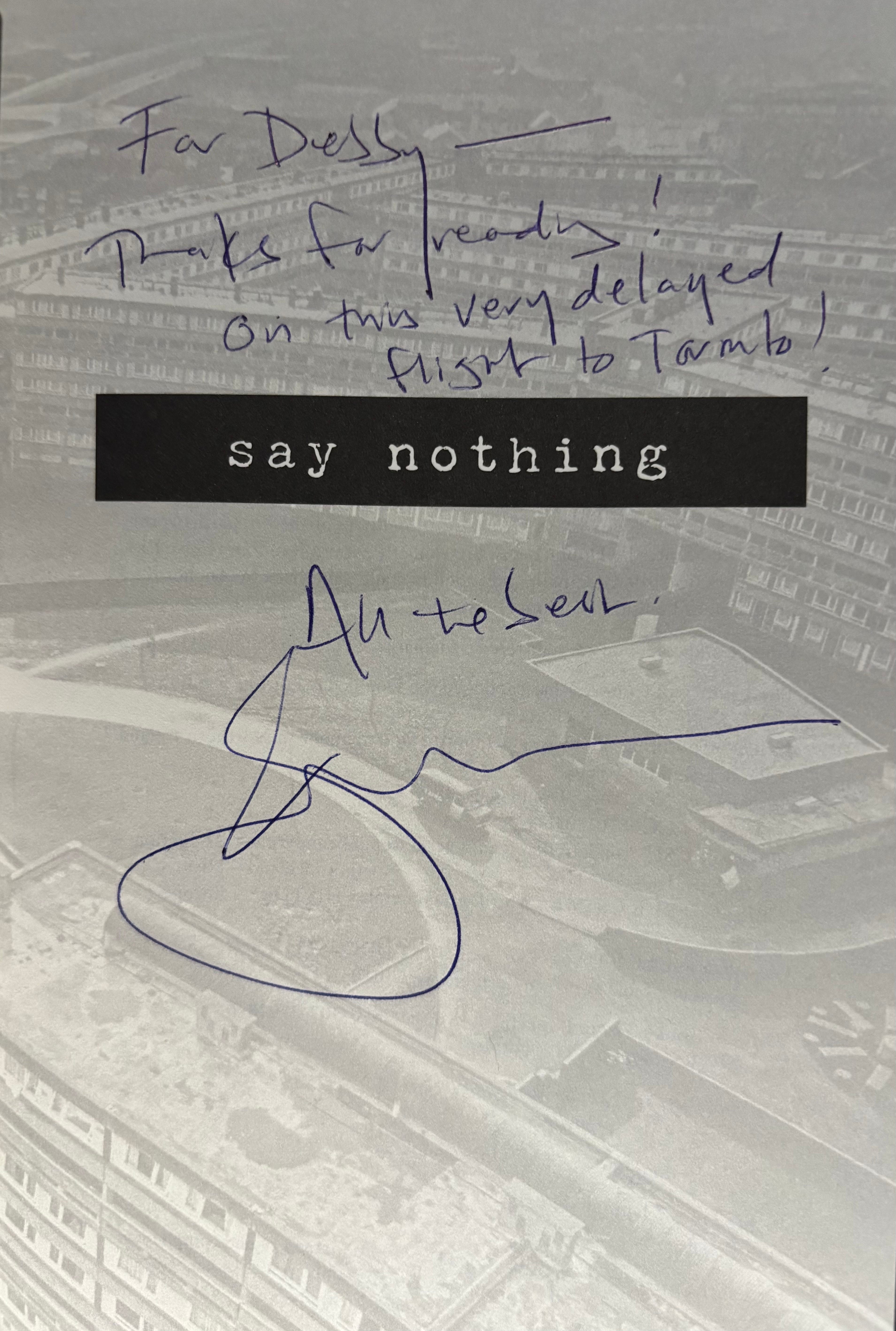
As I was thanking the flight attendant, Keefe turned around, smiled at me, and (I’m pretty sure) gave me a thumbs up. I admit, I was in a mild state of shock. I couldn’t stop smiling. I’d already texted my sister (a librarian), my niece (who loved London Falling), and the neighbor who told me that Say Nothing is one of the best books she’s ever read. They were as excited as I was.
Before the flight attendant headed off, I asked if he’d deliver my note. He politely informed me that he was finished being my carrier pigeon. “Just go talk to him,” he said.
“I can’t go into business class,” I said.
“It’s fine,” he said. “You can go up there.”
So up I went. Keefe was gracious and seemed both surprised and interested to learn that my father and Rachelle’s had been classmates in rabbinic school. Unfortunately (for me, at least) our conversation was cut short by the flight attendant assigned to business class.
“You have to go back to your seat,” she said. “There’s going to be turbulence.” I handed Keefe the barf bag, hoping that the turbulence wouldn’t be so bad that he’d have to use it for its intended purpose before he read the note.
The flight attendant trailed me back to Row 13. I assumed she was following me to ensure that I didn’t pester another passenger, but it turned out she wanted to fan-girl with me. “He’s such a great writer,” she said. “I read Say Nothing, too.”
I talked to Keefe briefly once more, as we were getting off the plane. He’d read my note by then and we marveled at the coincidences that had led to this particular moment. Then I decided to press my luck and ask for another favor. After reading London Falling, I’d sent an email to Rachelle, offering condolences, sharing my recollection of dinner with her family, and noting that we had more in common than either of us realized that night.3 I didn’t hear back from her—I hadn’t expected to—but I wondered if she’d received the email.
I mentioned that to Keefe before Dave and I sprinted through the airport to make our connection. “If you’re in touch with her,” I said, “maybe you can tell her that I wrote to her, tell her that you met me.”
He didn’t seem put off by the request, but again, I didn’t expect anything to come of it. And then, two days after I got home, a half hour after I finished reading Say Nothing, I turned on my computer, and there was a moving, heartfelt email from Rachelle. Patrick Radden Keefe had passed on the message.
I think it’s safe to say that when he wrote London Falling he was not thinking, “My book is going to help an ex-pat American in Edmonton finally put to rest an uncomfortable memory she’s been holding onto for 45 years.” As a friend of mine said when I related the story to her, “This is what art does: you put it out there in the world, and some people react to it and others don’t—it touches people in ways that nobody can expect.”
Ain’t that the truth.
I hope you enjoy reading this essay as much as I did writing it—not to mention as much as I did having the experience that led to my writing it. If you enjoy it, please restack! I’d like to think it’s an unusual enough story that other folks might find it interesting.
Most recent evidence that Dave would very likely not notice Einstein or Pauling: In May I made three casseroles, two for cousins who just became parents, one for Dave and me to eat for dinner. I left the house before the casseroles were finished. Dave had said he’d take them out of the oven but I forgot to tell him which one was for us and which I was giving away, and he wasn’t home when I left. I taped a note to the oven door handle so he wouldn’t miss it and he’d know which one he could eat for dinner. When I got home an hour later, the casseroles were on top of the oven, untouched. “I didn’t know which one to eat,” he said. I asked if he’d seen the note on the door handle. He had not. He had opened the oven, removed the casseroles, and completely missed the note. Einstein and Pauling could sit on his lap and he’d be so busy working that he wouldn’t notice.
He was as shocked as I was to discover that the guy whose book I had just bought really was on the plane—not to mention happy for me.
London Falling is about the secret that Rachelle’s son kept from her and her husband. In the book, Keefe also writes about a secret that Rachelle’s father kept from his family. He describes Rachelle as the daughter of a man who had secrets and the mother of a son who had them. I have described myself as the daughter of a man who died by suicide and the mother of a son who wanted to. Not exactly the same, but also not a description that I’ve heard ascribed to anyone else.
You truly lead a charmed life!
I enjoyed your post so much. I had read your previous one and loved it of my interest in the book. Also an interview with the author after I had read the new Yorker piece by him.